Paying with stablecoins
When the rail must fit the village
Design a conservation payment route that uses stablecoins only where they reduce friction, protect value, and remain usable for the people receiving the money.
Reading
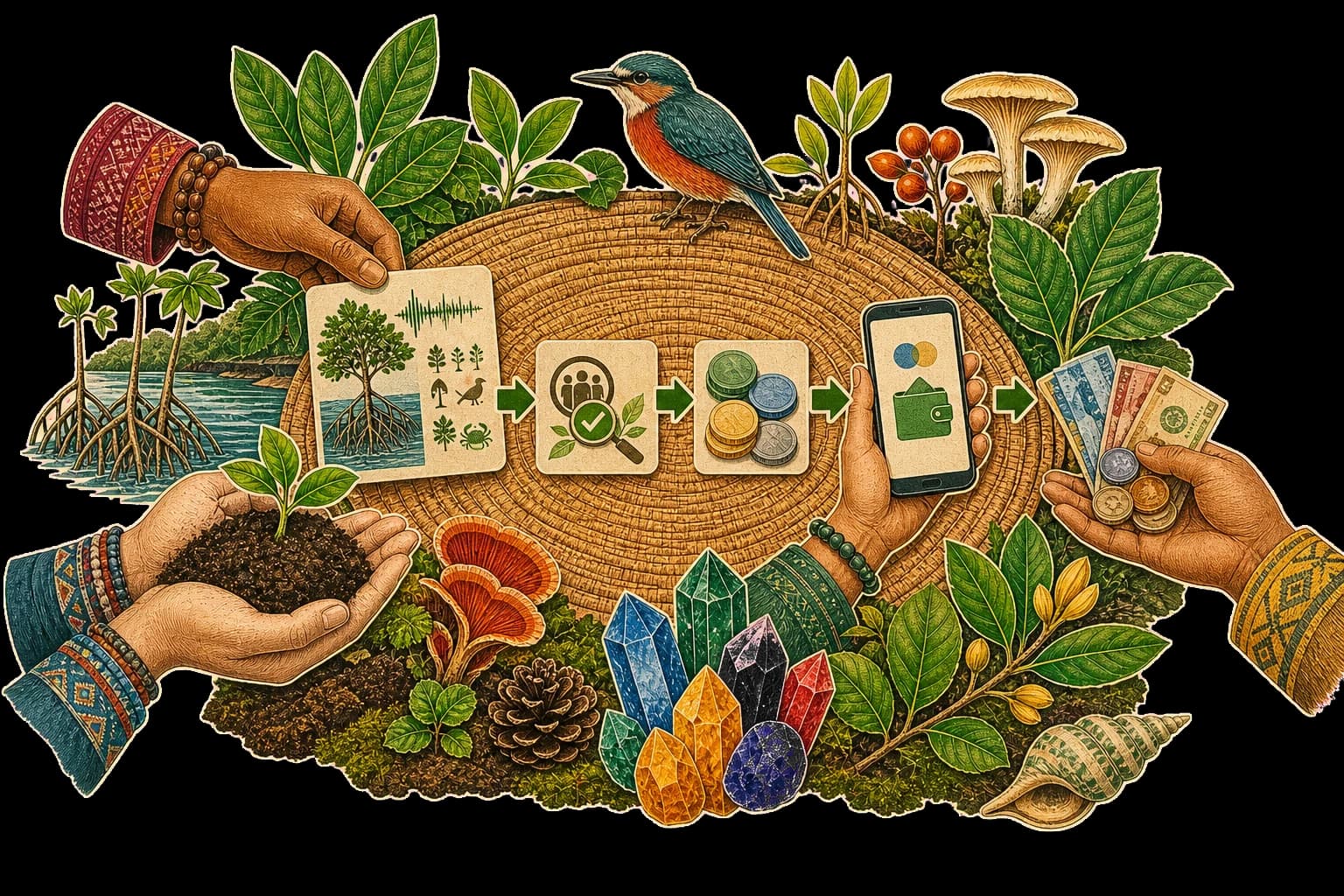
A stablecoin is a payment rail, not a justice guarantee. In the podcast conversation that anchors this lesson, GainForest describes the ambition plainly: trigger payments to communities with as few middlemen as possible, while making clear how those payments are triggered by an impact evaluator. The promise is speed, transparency, and a more direct path from recognised work to income.
The Philippines field note shows what happens when that promise meets the last mile. In Surigao del Sur, Oceanus Conservation worked with local fisherfolk collecting mangrove data for Conservation Data Income. Project funds moved from Philippine pesos into USDC, then through Decaf wallets, with cash-out possible through MoneyGram. The system opened a path for people without conventional bank access to receive value for data work.
But another option, GCrypto inside the popular GCash wallet, revealed the trap. Paying directly to phones sounded more convenient than travelling 35-45 minutes to town. Yet a 1 USDC transaction fee, additional cash-out fees at sari-sari stores, ID checks, scarce internet, and the simple trust of cash all changed the answer. Offered the option, community members still preferred cash. The best rail was not the most digital one; it was the one that delivered the most usable value.
That is the soil framing for stablecoins. Ask first what the community needs money to become: cash for food, a phone balance for bills, a wallet balance for online purchases, or a transparent record for a funder. Then count every invisible cost between the impact evaluator and the person being paid. A payment system is not finished when tokens move. It is finished when the recipient can actually use the value without losing dignity, privacy, or too much of the payment along the way.
Stablecoins can still matter. Local-currency stablecoins, lower fees, better identity options, and mobile-money integrations may make future conservation payments easier. But the design test stays the same: proof should trigger payment, governance should set the terms, and the route should be chosen by ground truth, not by Web3 excitement.
“How can we trigger payments to the communities, removing as many middlemen as possible, but also make it clear how these payments are triggered through an impact evaluator?”
Practise
Exercise
Map the last mile of a stablecoin payment
- 01Choose one Conservation Data Income payment: a day of mangrove survey work, a batch of bioacoustic minutes, or a drone imagery upload.
- 02Name the trigger. What proof, evaluator, or review step says the work is complete enough to pay?
- 03Draw the full route from funder to recipient: grant currency, stablecoin, project wallet, field wallet, mobile wallet, MoneyGram, cash, or another local rail.
- 04Write every cost beside the route: network fee, foreign exchange loss, cash-out fee, travel time, ID requirement, phone access, internet access, and who bears each cost.
- 05Add a fallback. If the stablecoin route fails, fees spike, or the recipient prefers cash, what path gets the most value to them without shame or delay?
Knowledge check
What is the main lesson from the Philippines stablecoin field test?
Why can a 1 USDC transaction fee be a serious problem for Conservation Data Income?
What role should an impact evaluator play in a payment flow?