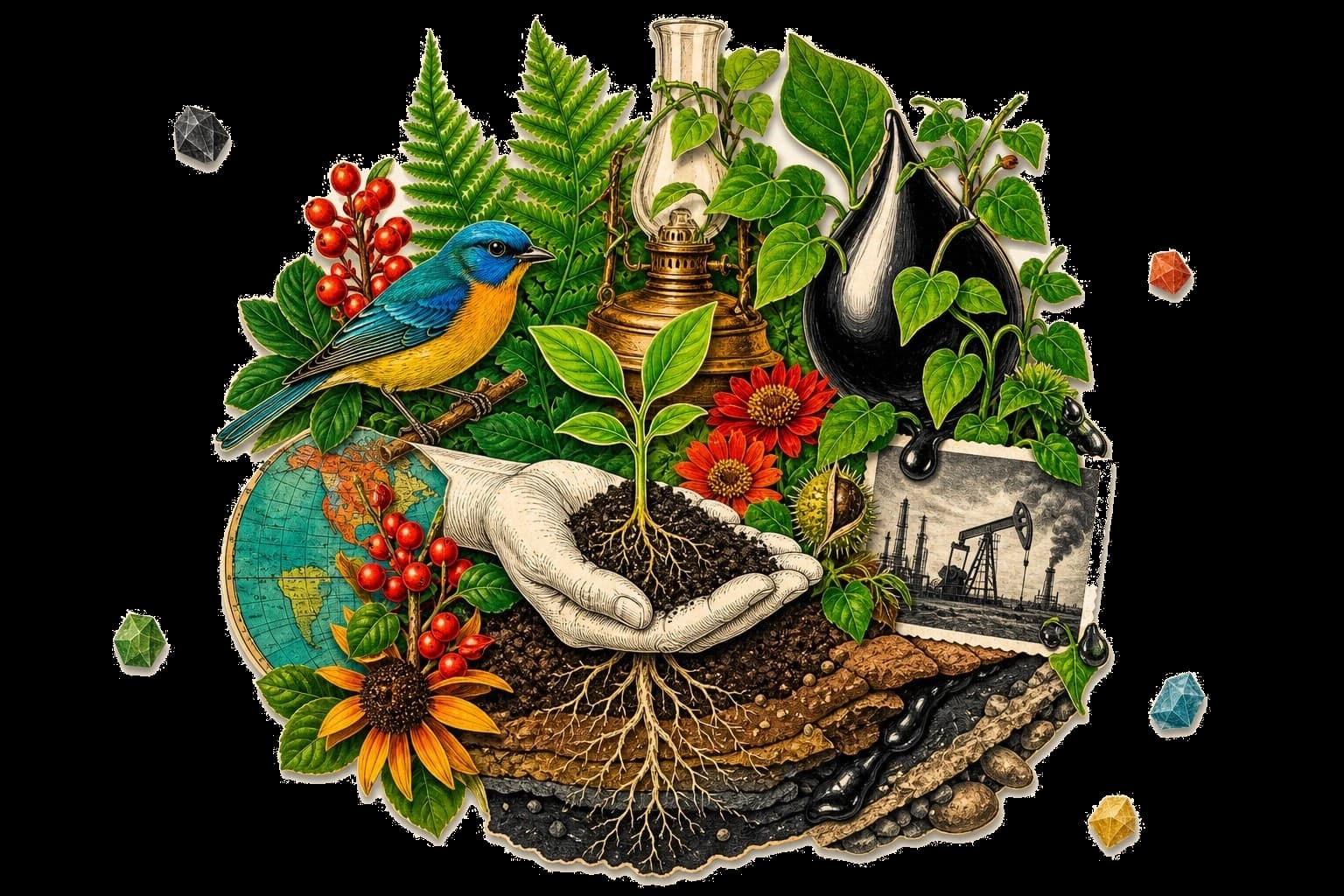
Soil over oil
Naming the frame you already use
See, with your own face in front of the camera, how a neural network depends on the data fed to it, and why the metaphor we use for that data, oil or soil, decides who gets to fix it when it fails.
Reading
What you just did, in twenty-five minutes on a laptop, is most of modern AI in miniature. A neural network is a function that learns by being shown examples. The classifier you trained had no opinion about faces; it had an opinion about the data you gave it. One hundred samples of one person and ten of another, and the model quietly decided that the second person did not really exist. Collect more, and they reappear. Almost every visible AI behaviour, helpful or harmful, can be traced back to a similar story about whose data was collected, in what volume, and on whose terms.
That is why the word data is doing so much hidden work in every conversation about AI, and why the metaphor we reach for matters. "Data is oil" is the dominant frame. It implies extraction (data is pulled out of a context), refinement elsewhere (cleaned and combined by parties the source has never met), and aggregation (more volume equals more value). The original context disappears into the barrel.
"Data is soil" begins with a different assumption: cultivation. Soil has seasons and meanings. It can be tended or neglected, planted or left fallow. When it becomes harmful, the people who tend it can correct it in place, rather than recall it from a downstream model trained in another jurisdiction. The group with 10 samples can add more samples; they cannot reach into a vendor's training set.
The GBIF map you just looked at is the same dynamic at planetary scale. Eighty-three per cent of the world's nature data is collected in North America and Europe; less than one per cent covers the rainforests that hold most of the species. Any model that trains on that map inherits the imbalance: it will be confident about the places that were already cared for, and silent about the places that were not. The fix is not a bigger model. The fix is who tends the ground in the places the data is missing from.
The metaphor matters because it sets the obligations. An oil dataset has a producer and a consumer. A soil dataset has a steward, a season, and a community whose work it depends on. Most of the practical disagreements about AI start, silently, with people using different metaphors and assuming the other person uses the same one.
“"Data is soil" assumes cultivation. It asks who tends the data, understands its seasons and meanings, can correct when it becomes harmful and decides what should be planted.”
Handouts for this lesson
Practise
Exercise 1
Train an AI on yourselves with Teachable Machine
- 01In each group, open https://teachablemachine.withgoogle.com and start a new Image Project. Briefly explain that almost all modern AI is a neural network: a function that learns to map inputs (here, webcam frames) to labels by being shown examples.
- 02Create two classes, one per group member. Pick the first person and hold the webcam button until you have collected around 100 image samples. Move their head, change angles, change expressions, so the dataset covers more than one pose.
- 03For the second person, on purpose, collect only about 10 samples. Click 'Train Model'. With both people sitting in front of the camera in turn, watch the live preview.
- 04Pause and discuss: why does the model confidently recognise the first person and fail, hesitate, or mis-label the second? Let the group answer in their own words before you name 'imbalanced training data'.
- 05Now collect roughly 100 samples of the second person as well, retrain, and test again. The model recovers. Note that some pairs of faces, similar lighting, similar features, are harder than others, but more representative data still resolves most of them.
- 06Optional stretch: try a class the model genuinely cannot tell apart from very little data, two near-identical pencils, two similar hand gestures. Discuss where 'more data' fixes the problem and where it just hides a deeper one (the labels are wrong, the camera is wrong, the question is wrong).
Exercise 2
Zoom out to the GBIF nature-data map
- 01Open https://www.gbif.org on the projector, the global database of biodiversity observations that scientists, governments, and AI models all draw on. Scroll down to the world map of occurrence records.
- 02Ask the group to read the map before you say anything. Where are the dense red zones? Where are the empty patches? Name the numbers out loud: more than 83% of the world's nature data sits in North America and Europe, around 17% covers everywhere else, and less than 1% covers the world's rainforests, the most biodiverse places on the planet.
- 03Let them figure out, in their own words, why this is a problem. Prompt only if needed: which species get conservation funding, which ecosystems get 'discovered' by AI, whose ecological knowledge counts as evidence, which forests get protected because a model can 'see' them?
- 04Close the loop back to the laptop. The same imbalance they engineered on Teachable Machine in five minutes is the imbalance the world has been engineering for two centuries on nature data. The fix is the same: collect with the missing communities, on their terms, and keep the data where they can tend it.
Knowledge check
Which of these is the strongest single-word summary of what the 'data is soil' frame implies?
In the Teachable Machine demo, the model failed on the person with only 10 samples. What was the most accurate description of what went wrong?
Roughly how much of the world's biodiversity data on GBIF is collected in the world's rainforests, the most species-rich places on the planet?
True or false: privacy compliance is enough for data sovereignty.