Local-first technology
Small models, held close
Choose when data, software, and AI should stay close to the community, and when outside infrastructure is worth the risk.
Reading
Local-first technology begins with a simple question: what should keep working if the internet disappears? In many conservation and community data projects, connectivity is slow, expensive, intermittent, or politically fragile. If the database, model, or payment dashboard only works through a distant service, then the community does not fully hold the tool.
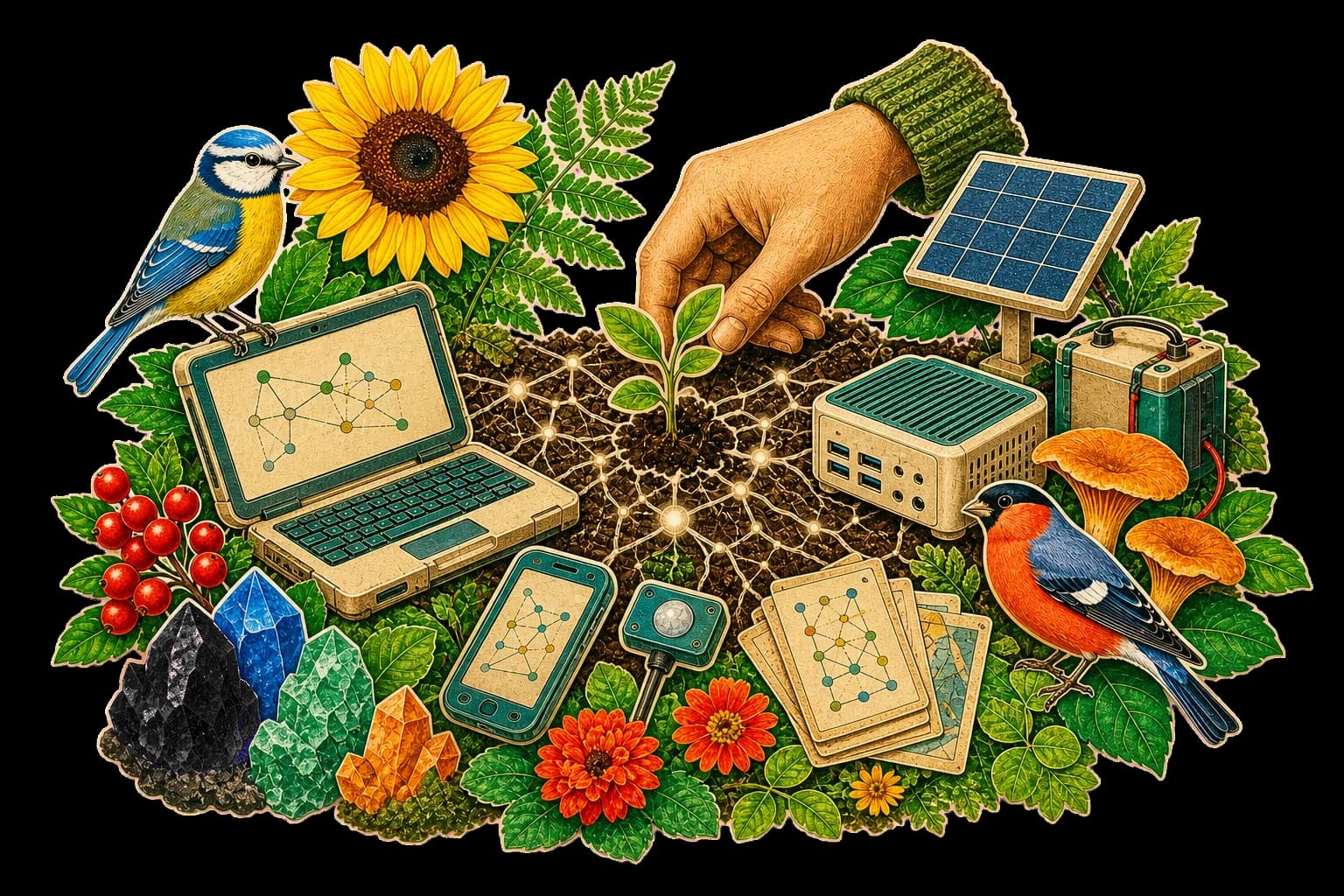
Local-first does not mean anti-cloud. It means the first copy, first decision, and first right to inspect should sit as close as possible to the people and places the data comes from. A phone can collect observations offline. A laptop can store recordings until review. A small server can hold a shared archive. A self-hosted or small AI model can answer some questions without sending private prompts, exact locations, or cultural knowledge to a remote provider.
This is also a lesson in frugal technology. The best tool is often the smallest one that can do the job: less bandwidth, less power, less maintenance, fewer hidden subscriptions, and fewer people needed to keep it alive. Frugal does not mean weak. It means repairable, teachable, portable, and honest about the real conditions of the field.
Self-hosted AI belongs in this framework because AI is not only a model; it is an infrastructure relationship. A community may choose a powerful remote model for translation, summarisation, or analysis when the benefit is clear and the data boundary allows it. But sensitive archives, land locations, sacred stories, identity documents, and refusal decisions may need a local model, a local index, or no AI at all.
The sovereignty test is practical: can the community read its data, run the core workflow, export the archive, audit what was sent out, and stop the system without losing everything? If yes, the technology is closer to soil. It can be tended, repaired, and governed in place.
“Technology needs to be localized.”
Practise
Exercise
Design the smallest stack that could work
- 01Choose one data task: recording biodiversity observations, translating community stories, auditing a certificate, or answering questions with an AI assistant.
- 02List what must work when the internet is slow, expensive, censored, or unavailable. Mark each item as local, sync-later, or cloud-only.
- 03Choose the most frugal version of each tool: paper, phone, laptop, local server, small model, self-hosted model, or remote API.
- 04Name what should never leave the community device without review: raw recordings, exact locations, sacred knowledge, identity documents, or private prompts.
- 05Write the exit plan. If the vendor, cloud account, or model provider disappears, what can the community still read, run, export, repair, or refuse?
Knowledge check
What does local-first technology mean in this course?
Why is frugal technology part of data sovereignty?
When might a self-hosted or small AI model be preferable to a remote AI API?