Drone mapping
Low-cost drones, RGB maps, and a river that changes
Plan and process one small low-cost drone survey, then turn the photos into a community-held map you can compare against next year.
Reading
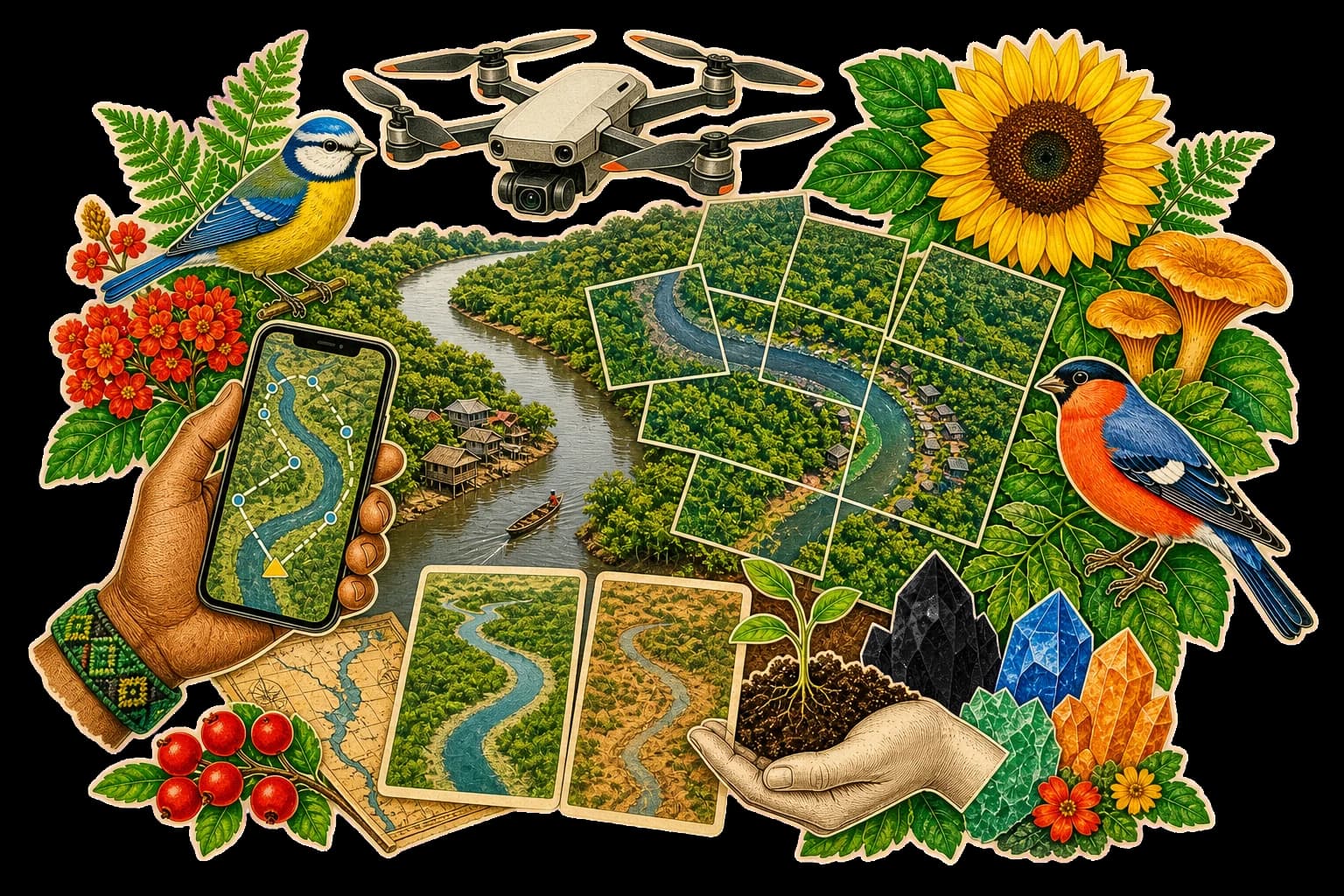
A low-cost drone is one of the most underrated community tools in this stack. A small consumer quadcopter under 250 grams, a phone, an SD card, and an open-source pipeline can give a village a record of its own land that no satellite report can match. In the field note that anchors this lesson, Rodrigo Ferreira, a programmer and drone pilot in Manaus, uses exactly that kit to map his wife's Indigenous village, the road in, and the river that is shrinking faster than the news can report.
The point is not that the drone is fancy. It is that the workflow fits the place. Plan a small flight, ideally 5–10 minutes and 50–100 overlapping photos. Choose a takeoff point you have actually walked to, with the tallest nearby tree in mind. Check the weather, pack sunscreen and repellent, bring spare batteries, and download the flight plan so it works offline. Fly automated grids when you can, with deliberate forward and side overlap so the stitch has no holes. Calibrate the sensors, watch the battery, and bring the drone back early rather than late.
What comes off the SD card is a folder of RGB JPEGs. An open-source pipeline, OpenDroneMap with the WebODM interface, runs locally in Docker on a community laptop and turns those photos into a stitched orthomosaic, a digital surface model that shows tree height, and a 3D point cloud you can rotate, measure, or even drop into Blender. The pipeline lives on the community's machine. The raw photos, the maps, and the decisions about who sees them stay close to home, which is the local-first commitment from the framework section made concrete.
One map is a snapshot. Six months of repeat maps is a witness.
The protective power shows up over time. Rodrigo's flights record this year's historic drought, the boats that cannot reach the village, the dying riverbank grass, and the ship terminal nearby. Next year's flights will show what came back, what did not, and which trees disappeared without permission. That is the soil framing of remote sensing: ecological data as a tended series, held by the people on the ground, with stablecoin or other payment routes (Lesson 12) recognising the work, the Data Council (Lesson 08) setting policy, and AudioMoth (Lesson 11) plus Taina (Lesson 10) adding sound and language to what the drone can see.
“Do regular mapping to see the changes. That's how we protect the nature.”
Practise
Exercise
Plan a 5–10 minute drone survey
- 01Pick one small area: a stretch of river, a stand of mangroves, a village edge, or a field at risk of clearing. Visit it on foot or on a satellite map first.
- 02Set the takeoff point. Walk to the spot you would actually launch from, note the tallest nearby tree, and set the flight altitude above it (often 60–90 m, with a hard ceiling around 120 m and local rules).
- 03Plan a grid in a drone-mapping app: 50–100 photos, 5–10 minutes of flight, with deliberate side and forward overlap so the stitched map has no holes.
- 04Pack the kit: drone, two or three spare batteries, charged phone, offline plan, SD card, hat, sunscreen, repellent, water, and a paper note of the start and end points.
- 05Decide the data path: where photos are stored after landing, who reviews them, and which images leave the community device. Mark anything that should stay local (homes, sacred sites, exact species locations).
Knowledge check
Why are short 5–10 minute missions with 50–100 photos a sensible default for low-cost drone mapping?
What does an open-source pipeline like WebODM / OpenDroneMap turn a folder of overlapping RGB drone photos into?
Why does the lesson insist on regular, repeat mapping of the same area?
Course complete
You’ve walked all 13 lessons.
Now run one in a room. Bring the handouts. Write back what changed.